The bot said "resolved". The customer called back.
By Janne Timonen, CEO

A chatbot was polite, quick and completely sure of itself. It asked for my customer number, my postcode and the reason I was contacting the company. Then it handed me to a person.
That person asked for my customer number, my postcode and the reason I was contacting the company.
On someone's dashboard, this probably looked like a successful AI-assisted conversation. From my side, it meant explaining the same billing issue twice. The handoff happened. The service did not hold together.
A conversation is not resolved just because the bot has stopped talking.
Automation is not the same as resolution
This experience came to mind when I read a Forbes Technology Council article by Niranjan Vijayaragavan, CTO of Five9. His argument, discussed in my original LinkedIn article, is that customer experience teams often ask the wrong question: how much can we automate?
A better question is how AI and people can work together in the conversations that need both.
Deflection and containment are easy to count. They can also hide a problem. If a customer cannot reach a person, closes the chat and calls again later, the cost has not disappeared. It has moved into the next contact, a complaint, or a decision to go elsewhere.
Containment tells you whether a conversation stayed with the AI. Resolution tells you whether the customer got the help they needed. Those are different things.
Three places where the handoff breaks
The same problems come up whether a business has a large contact center or a handful of people answering enquiries.
The customer repeats themselves. The person handling the follow-up spends time reconstructing the problem. Neither benefits from the automation that came before.
Design one conversation, not a relay race
A useful handoff is more than a transfer button. It carries the work already done into the next step.
Context should go with the customer, not stay behind with the bot.
What if nobody is free to take the call?
Most SMBs do not have a contact center. They have someone under a sink, with a patient, at the reception desk or in a meeting.
For these businesses, a live transfer cannot be the only way to handle a conversation that needs a person. A handoff must also work when the person becomes available later.
The AI should capture what it has learned and, through the business's configured connections, put it somewhere the team will actually see it. That might be a ticketing system, a CRM or email. The right destination is the one the business already uses.
The useful information is simple: who contacted the business, what they need, how urgent it is, what has already been answered and what still requires a decision.
Context arrives before the person does
Imagine a customer calling a plumbing business about a leaking water heater. This is an illustrative example, not a customer case.
The plumber cannot answer immediately. The AI records the issue, the address, the customer's availability and any information it has already provided from the business's approved knowledge.
When the plumber returns the call, the conversation can begin with the problem itself, not another round of "What were you calling about?"
The AI has not fixed the water heater. It has made the next human step useful. That distinction matters.
A simple test for your next review
You do not need a new dashboard to find out whether your handoffs work.
Take a sample of escalated conversations and check how often the customer had to repeat information. Then look at repeat contacts alongside containment. If the same unresolved issues keep returning, a high containment rate is not the whole story.
For an SMB, the test is even simpler: read what reached the inbox or CRM after the AI conversation. Could the person act on it without first asking the customer what they wanted?
If not, improve the handoff before celebrating the automation.
Why this matters to LastBot partners
LastBot ONE is delivered through partners: telecom operators, PBX providers, software vendors and resellers who bring AI customer service to SMBs.
The small business does not buy a containment figure. It wants customers to get help and unresolved requests to reach the right person with enough information to act. For partners, that makes the quality of the handoff part of the service, not an optional detail.
Across voice calls, WhatsApp, email and website chat, the goal is the same: preserve the conversation when human judgment is needed. The destination and escalation process should fit the business, with access rules and integrations configured for its needs.
The best experience is not necessarily the one with the highest automation figure. It is the one where the customer does not have to start again, even when the person arrives later.
Explore our integrations, or become a partner to discuss how LastBot ONE can fit into the services you already deliver.
Source
Adapted from Janne Timonen's original LinkedIn article, published on November 5, 2026. The original discusses Niranjan Vijayaragavan's Forbes Technology Council article on designing AI and human customer service as one connected experience.
Related posts
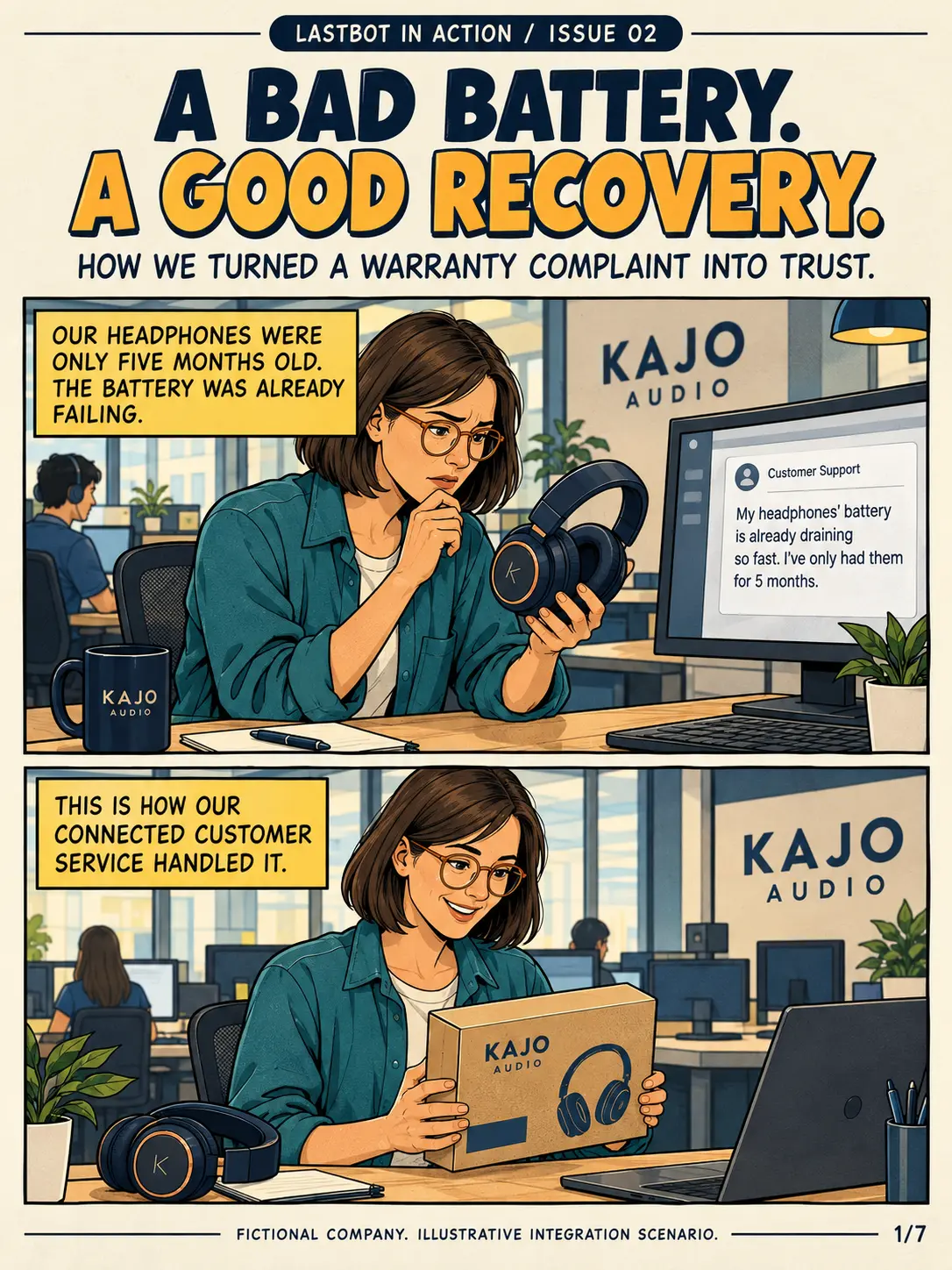
A Bad Battery. A Good Recovery.
A comic about a five-month-old pair of headphones, a failing battery, and how connected AI customer service turned a warranty complaint into trust by checking the backend, CRM and ERP before answering.
Read the article
Your Chat Widget Is the Most Boring Thing on Your Website
Ten SaaS homepages, one identical purple bubble in the corner. The chat widget is the first employee every visitor meets, yet almost nobody designs it. Here is why sameness is a choice, and what to change before you ship the next widget.
Read the article
How a Non-Technical CEO Built a Real Backend Integration in an Afternoon
Building an integration between an AI customer service platform and a customer's backend used to require an engineer, a project plan, and a budget. It does not anymore. Here is exactly how I did it, as a non-technical CEO, using two API descriptions, an LLM, and the LastBot interface.
Read the articleOffer LastBot ONE to your customers
Telecom operators, PBX vendors, software vendors and resellers can white-label, embed or resell it.